The mistake most “BBC onion link” lists make is to give you dozens of long addresses, one for each language, as though each were a separate site that had to be trusted individually. That is not the case. The BBC has a single onion address, and Deutsche Welle has one as well. Every language version, whether it’s Persian or Pidgin, sits behind that same address as a simple path, just as bbc.com/persian sits behind bbc.com.
That changes how you should think about safety. A fake site can only deceive you through its address, the long string that comes before .onion. The part after the slash, such as /russian or /fa-ir/, cannot make a site more or less genuine. So you only need to check two addresses carefully, once each. After that, each of the 70-plus language versions listed below is simply a matter of typing the right ending.
This guide is built on that idea. It explains why these two broadcasters put their news on Tor and shows how to find and check their real addresses. It then lists every language version with its path, so you can bookmark the one you want. It also covers what changed in 2026, a year of budget cuts, reversals and relaunches at both the BBC World Service and DW, and what to do if Tor itself is blocked where you live.
The information here is up to date as of 20 October 2026, and it reflects the current stable Tor Browser 15.0.25. If any Tor terms are unfamiliar, our Tor glossary explains them in plain English.
Why two public broadcasters run onion sites#
The BBC launched its onion site on 23 October 2019, carrying its international news as well as the foreign-language editions of the World Service. The official reason was that people in countries where BBC News is blocked or restricted should still be able to reach it, and the coverage at the time named China, Iran and Vietnam among them. Deutsche Welle, Germany’s international broadcaster, has also offered its websites as an onion service since 2019, for the same reason.
Seven years on, the case has become stronger, not weaker. Russia blocked BBC News in March 2022, and in December 2025 it added DW to its list of “undesirable organisations”, which makes cooperating with DW a criminal risk inside the country. Iran has blocked both for many years. For people in countries like these, onion sites are not a novelty. They are one of the very few ways left to reach news that the state doesn’t control.
What an onion site does that a VPN can’t#
You may wonder why anyone would bother with Tor when a VPN can also get around a block. There are three reasons, and they matter most in exactly the countries these sites were built for.
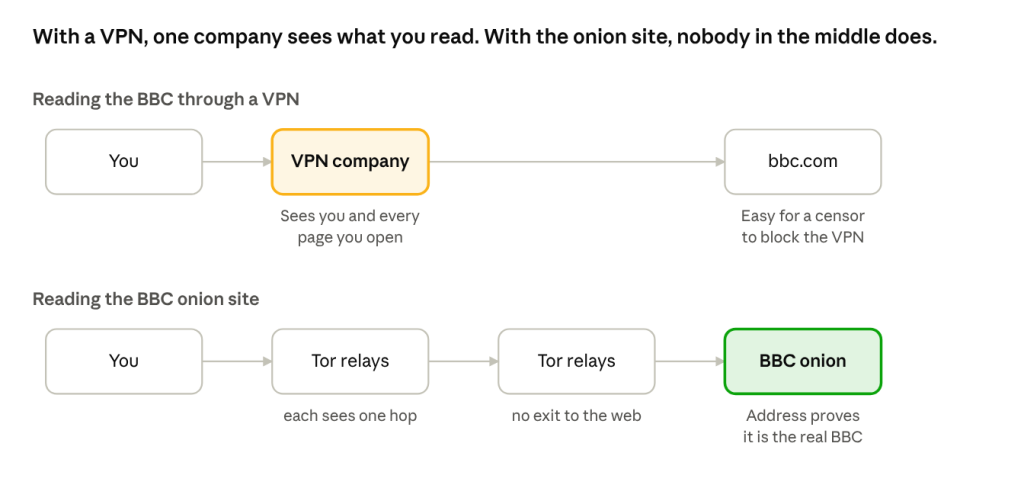
There is no company to block or pressure. A censor can find and block a popular VPN service, and many do. It can also put pressure on the company that runs it. An onion site has no single provider in the middle, and if you use it together with a Tor bridge, the censor may not even realise that you are using Tor.
Nothing leaves the Tor network. If you read the BBC through a VPN, the VPN provider can see which pages you open. On the onion site, the connection stays inside Tor from end to end, with no exit relay and no intermediary that can see both you and the BBC.
The address proves who you’re talking to. A v3 onion address is the site’s public key written out in full. When you reach the correct address, you are reading the real BBC or DW, not a copy set up to spread false stories under a trusted name. That matters in a propaganda war, since fake news sites posing as real broadcasters are a well-known tactic.
There’s a more detailed comparison in our Tor Browser vs VPN guide, and our explainer on what an onion service is describes how the address-as-key idea works.
One limitation to know from the start. The onion sites carry news, articles and much of the video, but UK-only services such as BBC iPlayer are not included, because they are restricted by broadcasting rights.
Finding and checking the two real addresses#
This is the only part that needs real care, and you only do it once for each broadcaster.
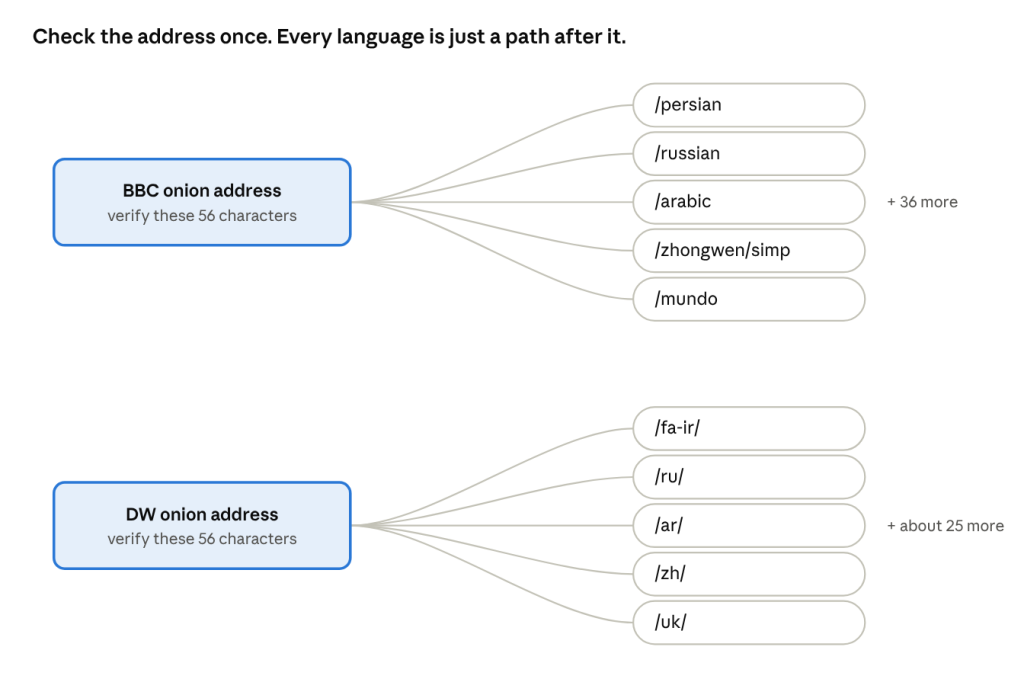
A v3 onion address consists of 56 letters and digits followed by .onion. Because it works as the site’s cryptographic key, nobody can run a website at the BBC’s exact address without the BBC’s private key. Any copy has to use a different address, usually one that looks similar at first sight. So the whole job is making sure you have the genuine 56 characters.
- Get Tor Browser from the official website. Download it only from the Tor Project’s download page, or through the Tor Project’s GetTor service if that page is blocked. Our guide explains how to install Tor Browser safely.
- Visit the broadcaster’s regular site in Tor Browser first. Type bbc.com or dw.com yourself. If the site advertises its onion version through Onion-Location, Tor Browser shows a purple “.onion available” button in the address bar. Because that button comes straight from the broadcaster’s own website, it is the most reliable way in.
- Cross-check with a separate, independent source. The BBC gave its address in its own launch announcement in 2019, and DW publishes its onion address on its own website. The long-running Real-World Onion Sites list on GitHub tracks the BBC’s address and all of its language paths, and so does our official onion mirrors directory.
- Check all 56 characters, not just the first few. The BBC’s address does begin with “bbcnews”, which is a good sign, but a scammer could generate a fake address with the same first seven characters in an afternoon. Compare the address in chunks of eight.
- Bookmark the verified address. From then on, open that bookmark and add the language path from the tables below. Never search for “BBC onion” again and click whatever comes up.
If an onion site claiming to be the BBC or DW asks you to log in, pay, install software or give personal details, it’s a fake. Neither broadcaster needs any of that for you to read the news. Our guides on how to verify an onion address and how to spot onion phishing and fake mirrors go into more detail, and hidden wiki scams explained shows the tricks used on Tor link lists.
The directory: every language edition#
Add the path to the end of the verified onion address. For example, if the BBC’s address were xyz.onion, BBC Persian would be xyz.onion/persian. If a path stops working, open the broadcaster’s language index (listed first in the BBC table) and pick your language from there. On the normal web, the BBC’s own language index shows the same list.
BBC World Service (42 editions)#
| Language | Path | Notes |
|---|---|---|
| All languages (index) | /ws/languages | Start here if a path below changes |
| English (international) | /news | BBC News international edition |
| Afaan Oromoo | /afaanoromoo | Ethiopia |
| Amharic | /amharic | Ethiopia |
| Arabic | /arabic | Online and TV only since radio closed in 2023 |
| Azerbaijani | /azeri | |
| Bengali | /bengali | Bangladesh and India |
| Burmese | /burmese | Myanmar |
| Chinese, simplified | /zhongwen/simp | Mainland China |
| Chinese, traditional | /zhongwen/trad | Hong Kong, Taiwan |
| French for Africa | /afrique | BBC Afrique |
| Gujarati | /gujarati | |
| Hausa | /hausa | West Africa |
| Hindi | /hindi | |
| Igbo | /igbo | Nigeria |
| Indonesian | /indonesia | |
| Kinyarwanda and Kirundi | /gahuza | BBC Gahuza, Rwanda and Burundi |
| Korean | /korean | |
| Kyrgyz | /kyrgyz | |
| Marathi | /marathi | |
| Nepali | /nepali | |
| Pashto | /pashto | Afghanistan, Pakistan |
| Persian | /persian | Iran, Afghanistan, Tajikistan |
| Pidgin | /pidgin | West Africa |
| Portuguese for Brazil | /portuguese | BBC Brasil |
| Punjabi | /punjabi | |
| Russian | /russian | Blocked in Russia since March 2022 |
| Serbian, Cyrillic | /serbian/cyr | |
| Serbian, Latin | /serbian/lat | |
| Sinhala | /sinhala | Sri Lanka |
| Somali | /somali | |
| Spanish for Latin America | /mundo | BBC Mundo |
| Swahili | /swahili | East Africa |
| Tamil | /tamil | |
| Telugu | /telugu | |
| Thai | /thai | |
| Tigrinya | /tigrinya | Eritrea, Ethiopia |
| Turkish | /turkce | |
| Ukrainian | /ukrainian | |
| Urdu | /urdu | |
| Uzbek | /uzbek | |
| Vietnamese | /vietnamese | Online only |
| Yoruba | /yoruba | Nigeria |
Some World Service editions aren’t in the tracked onion list yet, for example Japanese and the recently relaunched Polish (June 2025) and Hungarian (June 2026) services. They may still load through the onion site, so try the language index first.
Deutsche Welle (32 editions)#
| Language | Path | Notes |
|---|---|---|
| German | /de/ | DW’s home language |
| English | /en/ | |
| Albanian | /sq/ | |
| Amharic | /am/ | |
| Arabic | /ar/ | |
| Bengali | /bn/ | |
| Bosnian | /bs/ | |
| Bulgarian | /bg/ | |
| Chinese, simplified | /zh/?zhongwen=simp | |
| Chinese, traditional | /zh/?zhongwen=trad | |
| Croatian | /hr/ | |
| Dari | /fa-af/ | Afghanistan |
| Greek | /el/ | Kept after a 2026 reversal, in reduced form |
| Hausa | /ha/ | |
| Hindi | /hi/ | |
| Indonesian | /id/ | |
| Kiswahili | /sw/ | |
| Macedonian | /mk/ | |
| Pashto | /ps/ | |
| Persian | /fa-ir/ | Iran |
| Polish | /pl/ | |
| Portuguese for Africa | /pt-002/ | |
| Portuguese for Brazil | /pt-br/ | |
| Romanian | /ro/ | |
| Russian | /ru/ | DW is an “undesirable organisation” in Russia |
| Serbian | /sr/ | |
| Spanish | /es/ | |
| French | /fr/ | |
| Tamil | /ta/ | |
| Turkish | /tr/ | |
| Ukrainian | /uk/ | |
| Urdu | /ur/ |
DW’s onion site mirrors the structure of dw.com, so each path matches the language code DW uses on its regular website. If one ever fails, go to the onion homepage and use DW’s own language menu.
That’s 74 editions behind just two addresses. If you only need one, bookmark it directly so you never have to retype the path. And if you read the news in more than one language, it’s worth comparing how the BBC and DW report the same story, since they are funded by different governments and have different editorial policies.
What changed in 2026#
Both broadcasters spent 2026 under real financial pressure. The onion sites simply mirror the main websites, so when a language service shrinks or closes, its onion edition goes with it. Here’s what happened this year.
| Date | Broadcaster | What happened |
|---|---|---|
| 18 Sep 2026 | DW | Reversed its plan to close the Greek service. It continues in reduced form from January 2027 |
| 16 Jun 2026 | BBC | Hungarian service relaunched |
| 13 Mar 2026 | BBC | UK Parliament committee warned the World Service is losing ground to Russian and Chinese state media |
| Mar 2026 | BBC | UK Foreign Office funding raised 8% over three years, roughly matching inflation |
| Feb 2026 | DW | Announced 160 job cuts and a €21 million savings plan after a €10 million cut in federal funding |
| 31 Dec 2025 | DW | Ended shortwave radio broadcasting |
| Dec 2025 | DW | Added to Russia’s list of “undesirable organisations” |
The BBC World Service, under pressure#
In March 2026 the UK Parliament’s Public Accounts Committee published a blunt report. It found that the World Service’s total budget had fallen 21% in real terms between 2021-22 and 2025-26, and that its digital audience had dropped 11% over roughly the same period. Meanwhile, Russia and China together spend an estimated £6 billion to £8 billion a year on global media. The service still reaches an average of 313 million people each week in 43 languages.
The encouraging news for readers is that no language service has closed. When the BBC announced 130 job cuts in January 2025, it said all of its existing language services would stay, with some teams reorganised to put more weight on digital work. That shift matters for onion users, because digital output is exactly what the onion site carries. Two services have even come back. Polish relaunched in June 2025 and Hungarian in June 2026.
DW’s year of cuts and one reversal#
DW had a harder time. After the German government cut its funding by €10 million for 2026, DW’s management adopted a €21 million cost-cutting plan in February and announced 160 job cuts, including the closure of its Greek service. After a union campaign and a decision by DW’s Broadcasting Council, management changed its mind on 18 September. Greek will continue from January 2027, but with a budget of about €400,000 a year rather than €700,000.
DW also switched off its shortwave radio service at the end of 2025. For people in remote or tightly controlled areas, that leaves the website, and therefore the onion site, as the main way in. In Russia, since DW was named an “undesirable organisation” in December 2025, the onion site has become more useful than ever, and reading it carefully has become more important too.
What this means if you rely on these editions#
Keep your bookmark for the main onion address, not just the address of one language edition. The path might change if an edition is cut back or reorganised, but the address won’t. And if the language you want isn’t listed on this page, check the broadcaster’s index page through the onion site before concluding it has gone.
When Tor itself is blocked#
In the countries where these sites matter most, Tor is often blocked too. That’s what bridges are for. They are unlisted entry points into Tor, and Tor Browser has them built in.
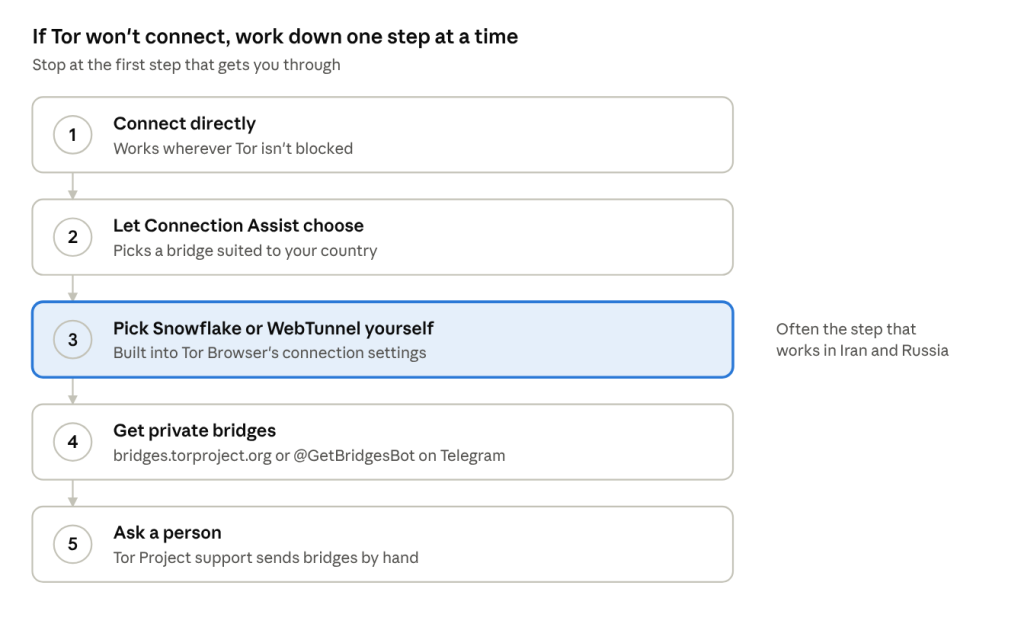
- Let Connection Assist try first. If a direct connection fails, Tor Browser offers to pick a bridge suited to your country.
- Try Snowflake or WebTunnel. Snowflake disguises your connection as a video call through volunteer proxies, and WebTunnel makes it look like ordinary web browsing. Both are in Tor Browser’s connection settings.
- Get fresh bridges. Built-in bridges tend to be blocked quickly in Russia and Iran. Ask for private ones at bridges.torproject.org or from the Tor Project’s @GetBridgesBot on Telegram.
- Ask a person. The Tor Project’s support team answers in several languages and can send bridges that aren’t handed out automatically. The Tor support pages also give country-by-country advice.
Our complete guide to bridges, Snowflake and WebTunnel gives the details for each country, and if Tor isn’t connecting for some other reason, try our nine fixes for Tor connection problems. If you live somewhere uncensored, you can help people on the other side of these blocks by running a Snowflake proxy, as explained in how to help the Tor network.
On a phone, Tor Browser for Android has the same bridge options, and the Tor Project recommends Onion Browser for iPhone users. Our guide to using Tor on Android and iOS covers both, and the newer Tor VPN beta for Android can route other apps through Tor too, although it isn’t yet meant for high-risk use.
Reading safely#
Reading the news on an onion site is generally low risk, but a few habits make it even lower.
- Don’t log in to anything. You can read the BBC or DW without an account. If you sign in to comment or save articles, you’ve told the site who you are.
- Raise your security level if you’re at risk. Tor Browser’s Safer and Safest settings turn off features that have been used in attacks. Some videos may stop working, but articles will still load. See Tor Browser security levels explained.
- Be careful with downloads and shares. A PDF or video you save stays on your device after you close Tor Browser. And sharing a link from your regular social media account undoes the privacy you’ve just had.
- Know the law where you are. Reading foreign news through Tor is legal in most countries, but in a few, using Tor or engaging with “undesirable” outlets carries real risk. Our note on the legal and ethical use of Tor has more, and the habits in Tor mistakes that break anonymity apply here too. For the highest-risk situations, Tails leaves no trace on the computer once you shut it down.
Other news outlets on Tor#
The BBC and DW have the widest range of languages, but they’re not alone. The New York Times and ProPublica run onion versions of their sites, and many major newsrooms take confidential tips over Tor through SecureDrop. Our official onion mirrors directory lists verified addresses, our monthly mirror status report shows which are currently up, and our SecureDrop directory explains how to send a tip safely.
The bottom line#
You don’t need a list of 74 onion links. You need two addresses you’ve checked properly and the habit of adding the right ending. Verify the BBC and DW addresses once, bookmark them, and the news in your language is a path away, whatever your government thinks of it.
Sources#
- BBC News launches Tor mirror site, TechRadar (October 2019)
- Deutsche Welle and BBC World Service, Wikipedia
- Real-World Onion Sites, Alec Muffett, GitHub (language paths)
- Russia and China flood airwaves as BBC World Service funding weakens, UK Parliament Public Accounts Committee (13 March 2026)
- BBC World Service to cut 130 roles, Press Gazette (January 2025)
- Deutsche Welle to cut 160 posts and close Greek service, Broadband TV News (February 2026)
- DW reversed decision to abolish Greek-language service, European Federation of Journalists (September 2026)